
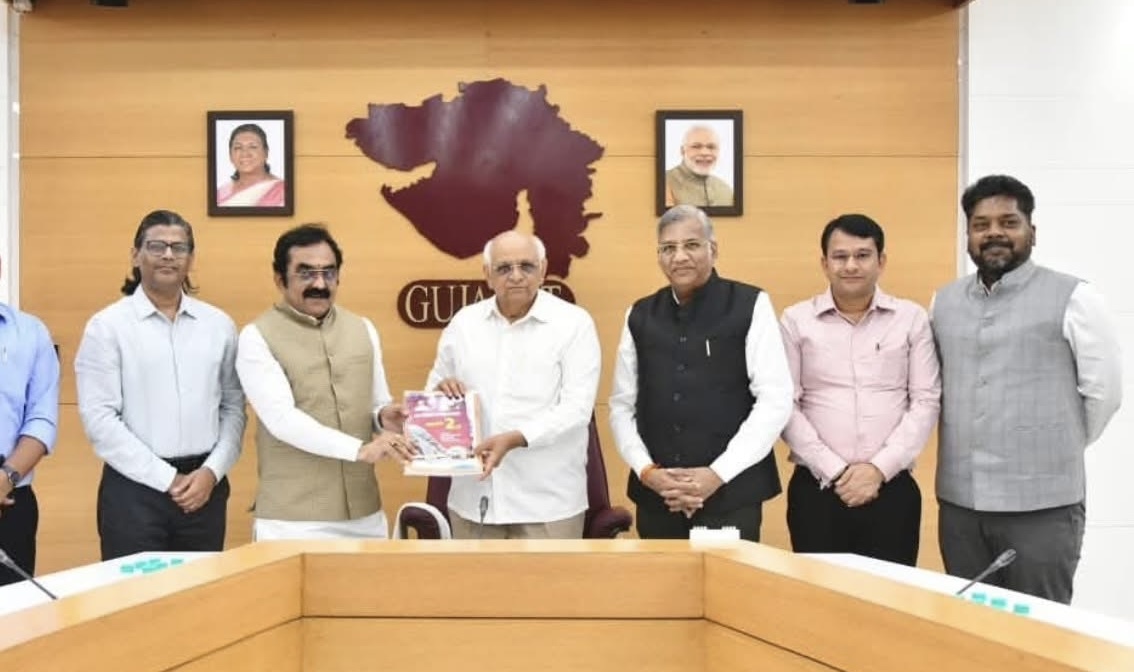
From BISAG-N to CMs’ Chambers: MP PWD Delegation Drives Knowledge Exchange on Modern Infrastructure
NEW DELHI/In a strategic initiative to benchmark global-best and national-leading practices in public infrastructure development, a high-powered delegation from Madhya Pradesh’s Public Works Department (PWD), led by Minister Rakesh Singh, concluded productive engagements with the Chief Ministers of Maharashtra and Gujarat.
Accompanied by senior officials including Principal Secretary Sukhveer Singh, Managing Director of MP Road Development Corporation Bharat Yadav, and Managing Director of MP Building Development Corporation Sibi Chakravarthy, the team engaged in high-level deliberations with Devendra Fadnavis, Chief Minister of Maharashtra, and Bhupendra Patel, Chief Minister of Gujarat.
The ongoing multi-state study tour encompasses key hubs in Maharashtra and Gujarat. Its core objective is to assimilate cutting-edge innovations in road construction, sustainable building technologies, project management efficiencies, and geospatial applications for infrastructure planning.
Key Highlights of the Engagements
During the meetings, the Madhya Pradesh delegation showcased transformative initiatives undertaken by the MP PWD, Madhya Pradesh Road Development Corporation (MPRDC), and Madhya Pradesh Building Development Corporation (MPBDC) over the past two years. These included advancements in quality assurance, rapid project execution, and adoption of environment-friendly construction methodologies.
Minister Rakesh Singh expressed profound appreciation for Gujarat’s exemplary governance model and work culture. “We are grateful to the Gujarat government for its exemplary work culture and best practices,” he remarked, underscoring the value of sustained technical collaboration and knowledge exchange between the two states.
A significant component of the Gujarat leg was the delegation’s visit to the Bhaskaracharya National Institute for Space Applications and Geo-informatics (BISAG-N) in Gandhinagar. BISAG-N, an autonomous scientific society under the Ministry of Electronics and Information Technology (MeitY), Government of India, serves as a national powerhouse in geospatial technology.
About BISAG-N
Established as a premier institution, BISAG-N specialises in three core domains: Satellite Communication, Geo-informatics, and Geospatial Technology. It delivers end-to-end solutions leveraging remote sensing, GIS, GPS, and satellite data for applications in agriculture, land & water resource management, urban planning, disaster management, infrastructure monitoring, and decision support systems. The institute plays a pivotal role in capacity building, research & development, technology transfer, and supporting state governments in evidence-based planning.
The delegation explored BISAG-N’s state-of-the-art facilities, focusing on its expertise in geospatial analytics for infrastructure projects — such as real-time monitoring of road networks, watershed management, crop monitoring, and integration of space technology for smart governance. These insights are expected to significantly enhance Madhya Pradesh’s capabilities in precision infrastructure development, predictive maintenance of assets, and sustainable resource utilisation.
Broader Strategic Implications
This proactive study tour exemplifies Madhya Pradesh’s forward-looking approach to elevating its public infrastructure ecosystem by learning from leading states. Officials aim to integrate acquired knowledge on advanced road maintenance techniques, green construction technologies, efficient procurement and execution models, and geospatial tools into ongoing and future departmental projects.
The visit also highlights the deepening spirit of cooperative federalism among BJP-ruled states, promoting the exchange of modern governance practices and technological innovations to accelerate India’s infrastructure growth trajectory.
As the delegation continues its engagements, further learning on emerging technology frameworks is anticipated, reinforcing Madhya Pradesh’s commitment to building world-class, resilient, and sustainable public works infrastructure for the benefit of its citizens.
